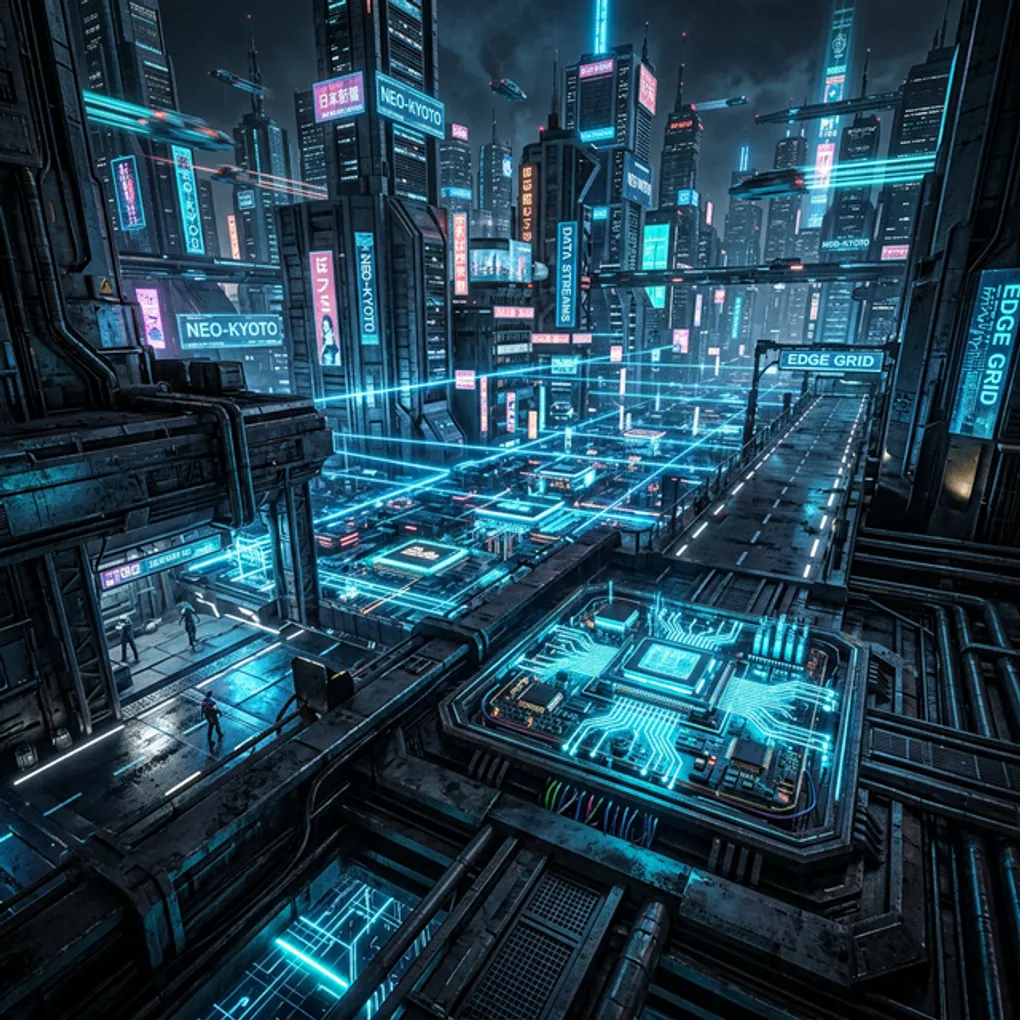
The Rise of Edge Computing and AI in IoT Devices: 2026
The explosive growth of connected devices and data-intensive applications has exposed the limitations of traditional cloud-centric computing models. In 2026, the tech industry is witnessing a massive paradigm shift toward Edge Computing, accelerated by the miniaturization of Artificial Intelligence hardware.
The Problem with Cloud-Only Architectures
Historically, Internet of Things (IoT) devices functioned as “dumb” sensors. They collected raw data (like video feeds, temperature readings, or audio clips) and transmitted everything to a centralized cloud server for processing. This model creates three critical bottlenecks:
- Latency: Transmitting data to a data center thousands of miles away and waiting for a response creates unacceptable delays for autonomous vehicles, industrial robotics, and medical devices.
- Bandwidth: Streaming 4K video from millions of security cameras 24/7 overburdens network infrastructure.
- Privacy and Security: Sending sensitive personal data across the internet increases the attack surface for bad actors.
What is Edge AI?
Edge AI refers to the deployment of machine learning algorithms directly on the local device or a nearby “edge server,” bypassing the need to send data to the cloud for real-time inference.
By processing data where it is generated, Edge AI provides near-instantaneous localized decision-making. The device only sends meaningful insights back to the cloud (e.g., “Person detected at the door” instead of the entire 1GB video file).
Key Enablers of Edge AI in 2026
The transition to Edge AI wouldn’t be possible without significant advancements in hardware and software optimization:
- Neural Processing Units (NPUs): Modern smartphone chips, smart cameras, and even tiny microcontrollers now feature dedicated NPUs. These are silicon structures designed specifically to perform the parallel matrix math required by neural networks at ultra-low power consumption.
- Model Quantization and Pruning: AI engineers can now take massive 32-bit floating-point models and “quantize” them down to 8-bit or 4-bit integers with negligible loss of accuracy. Pruning removes redundant neural connections, drastically reducing the model’s physical size and memory footprint.
- TinyML: A subfield of machine learning focused on running models on hardware with only kilobytes of RAM. TinyML allows a $2 microchip to perform voice recognition or predictive maintenance for years on a single coin-cell battery.
Industry Impact and Use Cases
The shift to Edge AI is revolutionizing multiple sectors:
1. Autonomous Vehicles and Smart Cities
Self-driving cars generate gigabytes of data every second from LIDAR, radar, and cameras. They cannot rely on a 5G connection to decide when to hit the brakes. Edge computing allows vehicles to process object detection and path planning instantaneously on local hardware. Similarly, smart city infrastructure uses edge nodes on traffic lights to optimize flow without congesting fiber backbones.
2. Industrial Manufacturing (Industry 4.0)
In modern factories, edge devices continuously monitor the vibration and acoustic signatures of heavy machinery. If an AI detects an anomaly indicating an impending bearing failure, it can shut down the machine automatically within milliseconds—preventing catastrophic damage that a cloud-based alert might miss due to latency.
3. Healthcare Privacy
Privacy laws like HIPAA and GDPR make transmitting raw medical data highly sensitive. Edge AI enables wearable devices to monitor EKGs and predict arrhythmias directly on the patient’s wrist. The data never leaves the device unless an emergency alert is triggered, ensuring profound data privacy.
The Future: Federated Learning
As edge devices become smarter, the next frontier is Federated Learning. Instead of sending raw user data to the cloud to train a master model, the master model is sent directly to millions of edge devices. Each device trains the model locally based on the user’s private data.
The edge device then sends only the mathematical update (the learned weights) back to the cloud. The cloud aggregates millions of these anonymous updates to improve the global AI model, completely preserving individual privacy.
Conclusion
The cloud isn’t dying, but its role is evolving. In the architecture of the future, the cloud serves as the master coordinator for heavy training and long-term analytics, while the decentralized Edge handles the real-time, high-speed execution. For software engineers and architects building the next generation of IoT platforms, mastering Edge AI deployment is no longer optional—it is the baseline.

